
Sparks Brain Preservation
A Non-profit Organization
If any portion of brain gets frozen, then ice crystals would form. As the ice expands, it would crush the delicate structures we are trying to preserve.
In all brain preservations, whether in chemical fixation or in Traditional Cryonics, there will be perfusion impairment in some areas. In traditional cryonics, this is far more consequential than in chemical fixation. In traditional cryonics, the perfusion impairment means that CPA will not be able to get into some of the capillary beds and freezing damage will be the result. These images show ice crystals in white or as voids, and they show how severely the brain tissue gets compressed in the remaining space between ice crystals.
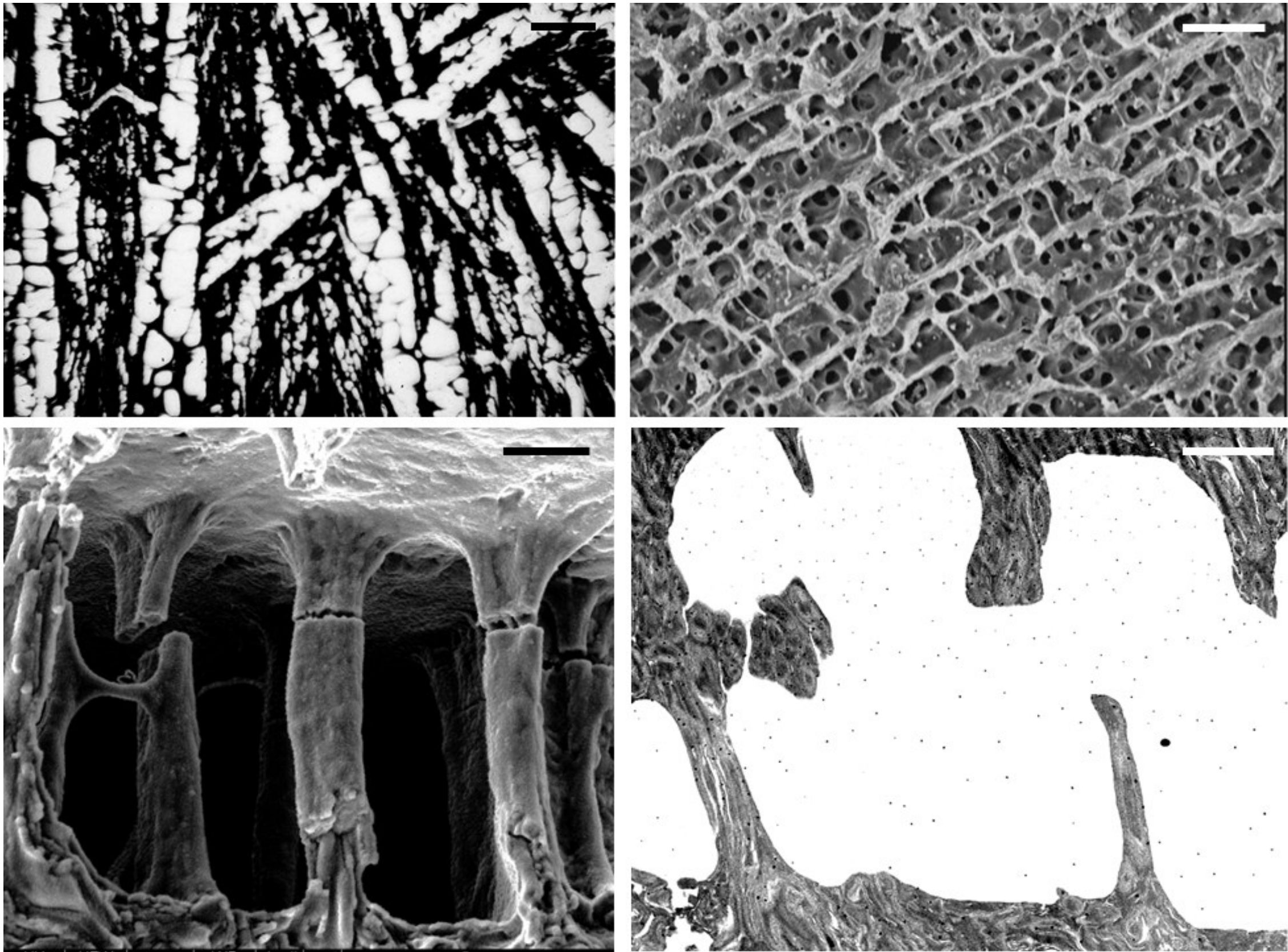
Can the original structure be inferred? Very likely not. The crushing action of ice is like a mortar and pestle. It doesn't just make it flat with compression forces, but it also "smears" the material with shearing forces between 25,000 and 114,000 psi. Any physical process that stirs or smears molecules causes a kind of damage which would not allow future inference of the original structure. You just can't unmix something. There's not enough information.
Based on these images, we work very hard to ensure adequate concentration of cryoprotective agent (CPA) everywhere before any subzero cooling takes place. Since we use aldehyde in all cases, it's fairly straightforward to use diffusion over about 10 months to achieve the desired CPA concentration. That seems so much better than traditional cryonics, where it's very common to have extensive areas of ice damage that are treated as unavoidable even though it is clearly avoidable 100% of the time.